Chat experiences are now part of everyday life, from quick website pop-ups to intelligent assistants that understand complex questions. But when teams start planning their own solution, one core question appears fast: chatbot vs virtual agent—what is the real difference, and which one should you invest in? Understanding this distinction is key to boosting agent productivity with intelligent assistance, helping your team serve customers more efficiently.
This Apsense Article: Boosting Agent Performance breaks down the concepts in clear, practical terms. You will learn how chatbots and virtual agents work, what each one is best at, and how to match the right technology to your goals, budget, and customer expectations.
In the modern business, integrating advanced technologies into everyday operations is no longer optional. Cloud-based artificial intelligence platforms for business automation are helping organizations manage large-scale data, streamline operations, and deliver faster services. Modern technology infrastructure and data-driven systems make it possible to analyze customer behavior, track performance, and predict needs with remarkable accuracy
Marketing teams are now using AI tools to create more personalized customer experiences, like automating social media posts, recommending content based on user interests, targeting the right audience at the right time, and running smarter online ads with AI. These tools help businesses connect with customers in meaningful ways, send messages that matter, and improve engagement and sales. They also allow teams to track campaign results, understand customer behavior, and make better decisions about marketing budgets.
Finance teams are also using AI to make work easier and more accurate. AI-powered financial tools help detect unusual activity, manage risks, and provide tailored advice. When combined with cloud-based systems, automated workflows, and virtual assistants, businesses can save time, reduce mistakes, and deliver faster, smarter service to both customers and employees.
The choice between chatbot vs virtual agent is therefore a strategic one, connecting AI, cloud computing, marketing intelligence, financial management, and modern IT infrastructure into a unified digital approach. Businesses that integrate these technologies can achieve seamless customer interactions, more effective marketing campaigns, better insights from big data, and improved overall productivity.
Top 10 Contact Center Solutions
When businesses evaluate modern customer service technology, the choice between chatbot vs virtual agent is crucial. The right solution can improve response times, reduce agent workloads, and deliver better customer experiences. Here’s a list of the top 10 contact center solutions, starting with Bright Pattern.
1. Bright Pattern – AI-Powered Contact Center Solutions
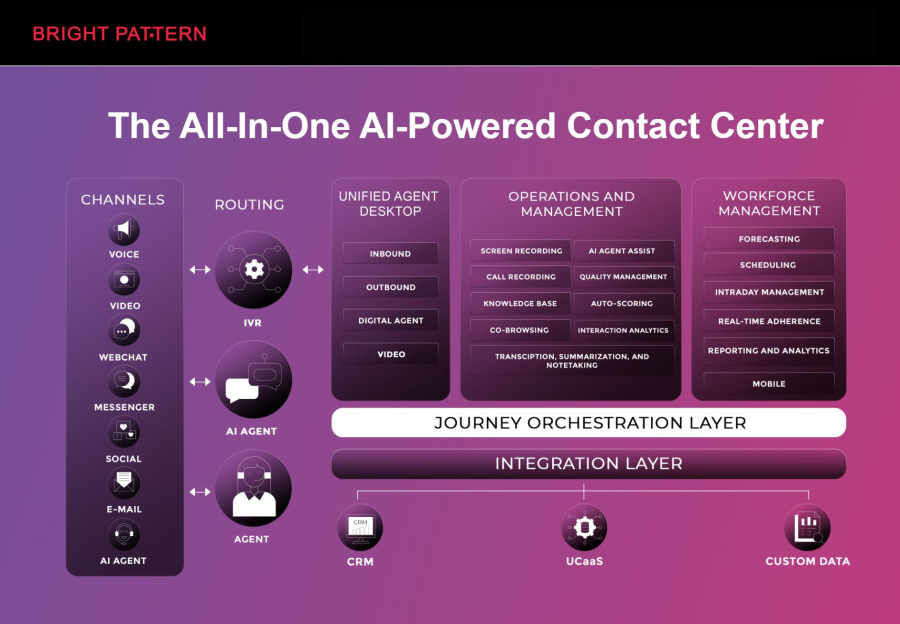
Bright Pattern stands out as a leading provider of cloud-based contact center solutions, offering a flexible and AI-driven platform that supports omnichannel customer interactions. Their technology helps businesses integrate chatbots, virtual agents, and human agents seamlessly, ensuring customers receive fast and intelligent support across voice, chat, email, and social media.
Key features:
- AI-powered virtual agents for 24/7 customer support
- Smart routing to connect customers with the best-suited agent
- Omnichannel integration across chat, voice, SMS, and social media
- Advanced analytics and reporting for performance monitoring
- Cloud-based deployment for scalability and easy updates
- Tools for boosting agent productivity and reducing response times
Bright Pattern’s platform is designed to make the chatbot and virtual agent decision simpler by allowing businesses to test, deploy, and optimize AI-assisted customer interactions alongside human agents.

2. Genesys – Cloud Contact Center Solutions
Genesys provides cloud-native contact center platforms with AI features that enhance customer engagement and automate routine tasks. Their solutions include AI chatbots, workforce optimization tools, and omnichannel capabilities.
3. Five9 – Intelligent Cloud Call Center Software
Five9 offers AI-driven call center software that integrates chatbots, predictive dialing, and analytics, helping companies improve agent efficiency and customer satisfaction.
4. Cisco Contact Center – Enterprise Customer Service Solutions
Cisco’s platform supports cloud and on-premise contact centers, with AI-based chat and voice assistants that help reduce agent workloads and streamline operations.
5. NICE inContact – AI and Cloud Contact Center
NICE inContact provides AI-powered virtual agents, omnichannel routing, and robust analytics to help organizations improve customer experience while optimizing call center performance.
6. Talkdesk – Cloud-Based Customer Experience Platform
Talkdesk offers AI-driven automation, intelligent routing, and integration with CRMs to support contact centers in managing high volumes of interactions efficiently.
7. Avaya OneCloud – Customer Engagement Solutions
Avaya OneCloud enables omnichannel communication with AI virtual assistants, workflow automation, and advanced reporting to enhance service quality and agent productivity.
8. Zendesk – Customer Support and AI Assistance
Zendesk’s platform combines chatbots, AI-powered recommendations, and analytics to streamline customer support and improve agent decision-making.
9. RingCentral Contact Center – AI-Enabled Communication
RingCentral provides cloud contact center solutions with AI virtual agents, speech analytics, and omnichannel management to enhance the customer journey.
10. 8x8 Contact Center – Unified AI-Powered Service
8x8 offers cloud-based contact center software with AI chatbots, analytics, and workflow automation, helping organizations optimize both agent and customer experiences.
What Is a Chatbot?
Achatbotis a software application that interacts with users through a chat interface using predefined rules, scripts, or basic natural language processing. In most cases, chatbots are designed to handlesimple, repetitive, and structured interactions.
Typical chatbot characteristics include:
- Works from predefined flows, buttons, or keyword triggers.
- Answers frequently asked questions such as opening hours, order status, or simple policy details.
- Often uses multiple choice menus to guide users through a decision tree.
- Usually focused on a narrow set of tasks, like lead capture or first-line support.
- Relatively fast and inexpensive to set up compared with more advanced solutions.
In short, chatbots are excellent atautomating straightforward questions and taskswhere the wording is predictable and the answers are well known in advance.
What Is a Virtual Agent?
Avirtual agent(often called a virtual assistant, intelligent virtual agent, or conversational AI agent) is a more advanced conversational system that usesnatural language understanding, context, and integrationsto handle richer, more complex interactions.
Typical virtual agent characteristics include:
- Uses advanced natural language understanding to interpret free‑form user input.
- Maintains context across multiple turns in a conversation.
- Connects to back‑end systems and data sources through APIs to perform actions, not just answer questions.
- Can personalize responses using customer history, preferences, or account data when allowed.
- Often supports voice, multiple languages, and omnichannel deployments.
Virtual agents are designed to act more like adigital team memberwho can both converse and complete tasks such as updating an address, changing a booking, or running a basic troubleshooting flow.
Chatbot vs Virtual Agent: Key Differences at a Glance
Both technologies live in chat windows and may look similar on the surface, but their capabilities are quite different. The table below summarizes the main distinctions.
|
Aspect |
Chatbot |
Virtual Agent |
|
Core approach |
Rule based, scripted flows |
AI driven, uses natural language understanding |
|
Complexity of tasks |
Simple, repetitive questions and actions |
More complex, multi‑step and context‑rich tasks |
|
Handling free‑form text |
Limited; often relies on buttons or keywords |
Strong; can interpret varied wording and phrasing |
|
Context retention |
Minimal context between messages |
Maintains context across the conversation |
|
Integrations |
May use simple integrations or none at all |
Designed to integrate deeply with systems and data |
|
Personalization |
Basic, often one‑size‑fits‑all responses |
High potential for personalized experiences |
|
Implementation time |
Fast for narrow, well defined use cases |
Longer, due to training, design, and integrations |
|
Typical investment |
Lower upfront costs |
Higher initial investment, stronger long‑term ROI |
When a Chatbot Is the Right Choice
Chatbots shine in scenarios where you wantquick wins with limited complexity. They are especially attractive for teams that are beginning their automation journey or working with a smaller budget.
Ideal Use Cases for Chatbots
- FAQ automation— Answer repeat questions about pricing, shipping, returns, or policies.
- Lead capture— Collect contact details, qualify visitors, and route them to sales.
- Basic self‑service— Provide instructions, how‑to steps, and links to helpful resources.
- Simple status checks— Show basic order or ticket status when connected to a system.
- Out‑of‑hours coverage— Offer instant answers when human agents are offline.
Benefits of Starting with a Chatbot
- Faster time to value— You can deploy a focused chatbot in days or weeks for a well defined use case.
- Lower risk and cost— A smaller scope means less complexity, making it easier to demonstrate early returns.
- Simple governance— With clear scripted flows, it is easy to review and approve all responses.
- Stepping stone to AI— Chatbots can act as a foundation that you later extend into a more sophisticated virtual agent.
For many organizations, a well designed chatbot already brings visible gains in responsiveness, customer satisfaction, and team productivity.
When a Virtual Agent Delivers More Value
A virtual agent is best when your organization is ready fordeeper automation and richer, more human like conversations. It moves beyond scripted decision trees and into dynamic problem solving.
Ideal Use Cases for Virtual Agents
- End‑to‑end task automation— Let customers change bookings, update details, or manage subscriptions entirely in chat.
- Technical troubleshooting— Guide users through multi‑step diagnostics and adapt based on their inputs.
- Account specific support— Surface order history, billing details, or personalized recommendations securely.
- High volume contact centers— Deflect a significant share of calls and chats by resolving complex queries digitally.
- Multilingual and omnichannel service— Provide consistent experiences across channels and languages.
Business Benefits of Virtual Agents
- Greater automation rates— Virtual agents can fully resolve a larger share of inquiries, not just FAQ‑type questions.
- More satisfying experiences— Natural language understanding and context make conversations feel smoother and more intuitive.
- Stronger personalization— Integrations and data access let the virtual agent tailor answers and offers to each user.
- Scalable support— As volume grows, you can handle more interactions without a linear increase in staffing.
- 24 / 7, consistent quality— The virtual agent delivers the same standard of service at any time and on every channel.
While the initial setup is more involved, organizations that invest in virtual agents often seesubstantial long term efficiency gains and improved customer satisfaction.
How to Decide: Chatbot vs Virtual Agent
There is no single right answer that fits every business. Instead, the best choice depends on yourgoals, volume, complexity, and available resources. The steps below can clarify which option is a better fit today — and how to scale up over time.
1. Map Your Use Cases
Start by listing the conversations you want to automate. For each one, check:
- Complexity— Is the request usually solved in one or two steps, or is it a multi‑step process?
- Variability— Do customers ask in similar ways, or do they use a wide range of phrases?
- Data access— Does the agent need to see account data or perform secure actions?
- Volume— How many times per month does this question appear?
Simple, high volume, low variability tasks are excellent candidates for achatbot. Complex, variable, or data rich tasks are usually better suited to avirtual agent.
2. Consider Customer Expectations
Your choice should align withhow critical the interaction is for your customers. For example:
- For informational questions like "What are your opening hours?", a chatbot is typically enough.
- For emotionally charged or high value moments such as canceling a contract, requesting a refund, or resolving a serious issue, a virtual agent or fast handoff to a human is more appropriate.
As expectations grow, customers increasingly appreciate solutions that understand natural language and can handle full tasks without transfers.
3. Evaluate Your Internal Capabilities
Chatbots are easier to launch with a small team. Virtual agents offer more power but require more preparation. Ask yourself:
- Do we have people who can design conversation flows and maintain content?
- Can we connect the solution to our systems such as CRM, helpdesk, or order management?
- What is our timeline for seeing results, and what budget can we commit?
If you are just getting started, it may be strategic tolaunch a focused chatbot first, gather data, and then evolve toward a virtual agent once you have proven value.
4. Plan for Handoffs to Human Agents
Regardless of your choice, an effective conversational strategy includessmooth escalation to human agents. This builds trust and keeps customer satisfaction high when automated support reaches its limits.
Best practices include:
- Clearly offering a "talk to a person" option for complex or sensitive queries.
- Transferring the conversation history so customers do not have to repeat themselves.
- Using the chatbot or virtual agent to collect key information before handing off, so human agents can help faster.
Design Tips for High Performing Chatbots and Virtual Agents
Whether you choose a chatbot or a virtual agent, thoughtful design multiplies the benefits. Well crafted experiences feel personal, efficient, and reliable.
Focus on Clear, Helpful Language
- Use simple, friendly wording that matches your brand voice.
- Ask one question at a time to keep users focused.
- Offer examples of what users can type, especially in the first message.
Guide Users, Do Not Overwhelm Them
- Provide quick reply buttons or suggested options where relevant.
- Give users shortcuts to the most common tasks, like "Track an order" or "Change my booking".
- Show progress in multi‑step processes so users know how many steps are left.
Use Data Responsibly and Transparently
Virtual agents, in particular, can access powerful data sources. To build lasting trust:
- Be transparent that users are talking to an automated system.
- Explain when data is used to personalize answers, in clear terms.
- Respect privacy choices and follow your organization’s policies and relevant regulations.
Continuously Improve with Real Conversations
The strongest results come fromongoing optimization. After launch, review:
- Which intents or topics are triggered most often.
- Where users drop out of flows or ask to speak to a person.
- Customer satisfaction ratings and comments after bot interactions.
Use these insights to refine responses, add missing paths, and adjust the balance between automation and human support.
Future Trends: Convergence of Chatbots and Virtual Agents
The line between chatbots and virtual agents is graduallyblurring. As conversational AI technologies advance, even simple bots gain more understanding, while enterprise‑grade virtual agents become easier and faster to deploy.
Key trends shaping the future include:
- More natural conversations— Improvements in language models and context handling make interactions feel smoother and more human like.
- Stronger integrations— Out of the box connectors simplify linking conversational tools to core systems.
- Unified orchestration— Businesses manage multiple bots and agents under one strategy, balancing cost, quality, and automation.
- Broader channels— The same virtual agent logic can serve web, mobile, social messaging, and voice interfaces.
As these trends continue, organizations that start building conversational capabilities today will be in a strong position to benefit from each new wave of innovation.
Conclusion: Choose the Right Starting Point, Then Evolve
Both chatbots and virtual agents can dramatically enhance how you engage with customers, prospects, and employees. The key is tomatch the solution to your current needs while keeping future growth in mind.
- Choose achatbotif you want a fast, focused way to automate simple, high volume questions and tasks.
- Choose avirtual agentif you are ready to automate more complex interactions, integrate with core systems, and deliver highly personalized experiences.
Many organizations start with a targeted chatbot, prove the value of conversational experiences, and then expand into a powerful virtual agent as their strategy matures. By taking a staged, outcome driven approach, you can unlock better service, higher satisfaction, and significant efficiency gains — one conversation at a time.
